170 Years Since the Birth of Ivan Franko
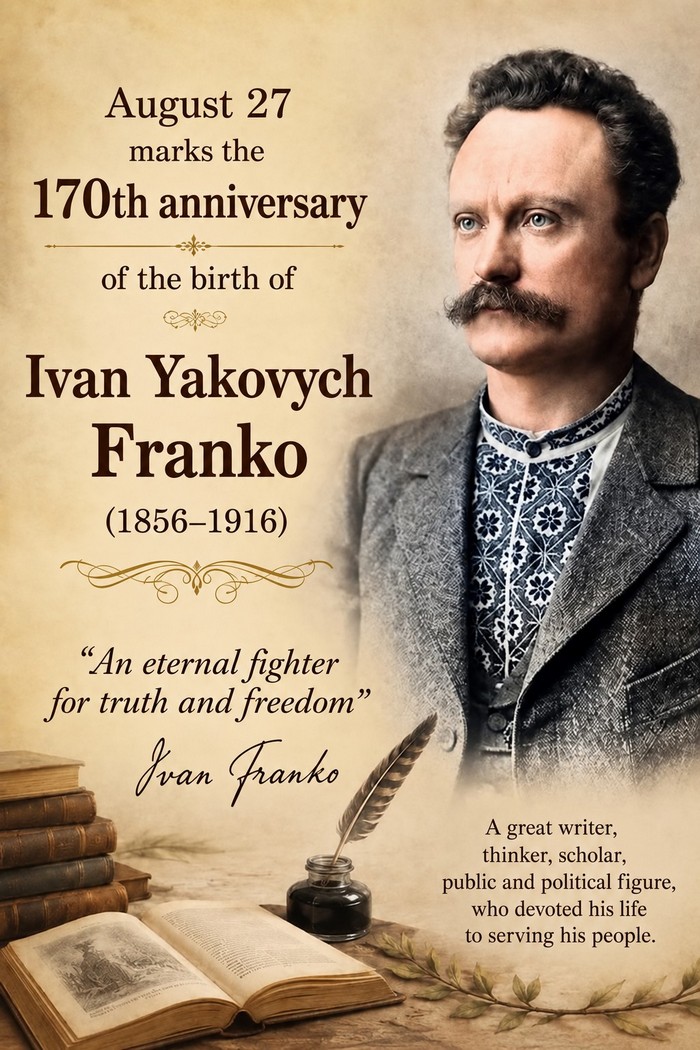
On August 27, 2026, we mark the 170th anniversary of the birth of Ivan Yakovych Franko (1856–1916) — one of the most outstanding figures in Ukrainian culture, a brilliant writer, poet, scholar, translator, thinker, and public figure.
Ivan Franko was a personality of exceptional scale. His work became an integral part of Ukrainian literature and national culture, and his contemporaries rightly called him “an academy in one person.” He was a poet and prose writer, playwright and publicist, folklorist, ethnographer, philosopher, economist, historian, and translator. Franko knew 14 languages and left behind an enormous literary and scholarly legacy.
Creative Legacy and Literary Masterpieces
The literary heritage of the great Ukrainian classic is remarkable for its diversity of genres and themes. The academic edition of Ivan Franko’s works comprises 50 volumes, yet researchers note that even this edition includes only part of what he wrote.
Poetry. Franko created outstanding examples of civic, philosophical, and intimate lyric poetry. Among his best-known poetic works and collections are “From the Heights and the Depths”, “Withered Leaves”, “My Emerald”, while the philosophical poem “Moses” holds a special place in his literary legacy.
Prose. His novels, novellas, and short stories became part of the golden treasury of Ukrainian literature. Among his most famous prose works are “Zakhar Berkut”, “Boryslav Laughs”, “Crossroads”, “The Foundations of Society”, as well as numerous short stories and novellas.
Drama. The psychological drama “Stolen Happiness” became a classic of Ukrainian theatre and has remained relevant to audiences and directors for generations.
An Outstanding Translator and Polyglot
Ivan Franko was not only a great writer, but also one of the most prolific Ukrainian translators of his time. He knew 14 languages, translated major works of world literature into Ukrainian, and introduced European readers to Ukrainian culture.
Thanks to his translation work, Ukrainian readers gained access to ancient and European classics, including works by Homer, Sophocles, Euripides, William Shakespeare, Johann Wolfgang von Goethe, Friedrich Schiller, Dante Alighieri, George Gordon Byron, Heinrich Heine, and many other authors.
For Franko, translation was much more than literary work. It was a way to bring Ukrainian culture into a broader European and global intellectual space.
Interesting Facts About Ivan Franko
- Extraordinary productivity. Ivan Franko left behind several thousand literary, journalistic, and scholarly works. He worked with exceptional intensity and published several books almost every year.
- Fourteen languages. Franko knew many European and classical languages, which allowed him to work with a vast body of world literature.
- Doctor of Philosophy. In 1893, Ivan Franko defended his doctoral dissertation in Vienna. His scholarly interests included literary studies, folklore, history, economics, ethnography, and philosophy.
- A distinctive personal style. The well-known image of Franko wearing a traditional Ukrainian embroidered shirt under a European-style suit became one of the most recognizable symbols of the Ukrainian intelligentsia of the late 19th and early 20th centuries.
- Nobel Prize nominee. Ivan Franko was officially nominated for the Nobel Prize in Literature in 1916. He died on May 28 of that same year.
The Wisdom of Ivan Franko
Ivan Franko’s work speaks about freedom, human dignity, education, work, responsibility, and the power of knowledge. His words have not lost their relevance today.
“Books are an ocean deep:
Whoever dives down to the bottom,
Though the effort may be great,
Brings back wondrous pearls.”
On the 170th anniversary of Ivan Franko’s birth, we invite our readers to rediscover his books, return to familiar works, and explore those pages of his immense legacy that may still remain unknown.
Ivan Franko belongs to those figures whose importance becomes even more evident with time. His work continues to help us better understand Ukraine, its literature, culture, history, and spiritual strength.